
 Dr. Christian Binek: Advancing Energy-Efficient Computing Through Federally Funded Research
Big Questions, Early Answers
With support from the National Science Foundation (NSF), Dr. Christian Binek studies quantum materials that could make computing more energy-efficient — work that may help meet the growing energy demands of emerging technologies.
His passion was sparked in elementary school, when his pastor encouraged him to explore life’s big questions. Dr. Binek soon discovered that science offered a way to do that.
He initially gravitated toward biology, chemistry, physics, and math. But the realization that mathematics and physics often explored the same concepts using a different language and symbols set him on an educational and career journey in the field of physics.
“As soon as that clicked for me, I got vastly more interested in physics,” Dr. Binek said. “That is a reminder of how important educators are, because it could have gone in any direction.”
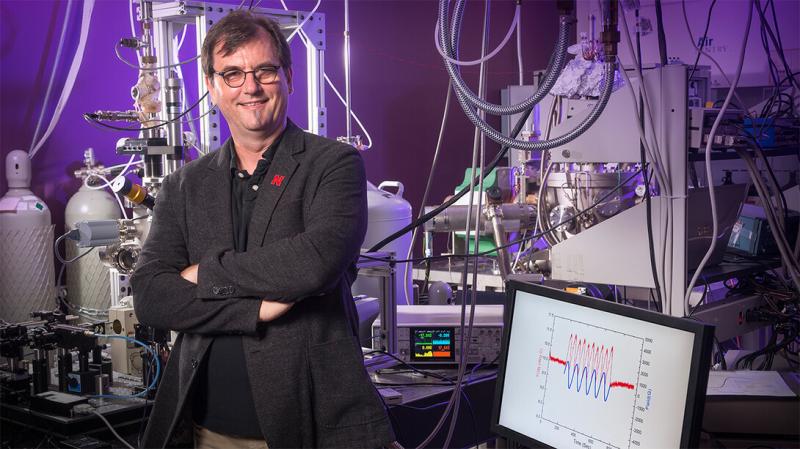 Dr. Binek at the University of Nebraska-Lincoln.
Building More Efficient Technologies
Modern computing requires enormous amounts of energy, and demand continues to grow with the expansion of AI. Today, Dr. Binek is the Paula and D.B. Varner Professor of Physics at the University of Nebraska–Lincoln and director of the Nebraska Center for Materials and Nanoscience, where he studies whether voltage can control a material’s magnetic properties without the flow of electric current, which consumes energy and produces heat. His research could lead to memory and logic devices that use less power.
“The big bottleneck in modern electronics is energy consumption,” Dr. Binek said. “And that is only getting worse.”
Through fundamental research, Dr. Binek and other scientists are able to investigate potential solutions before their practical or commercial applications are fully known.
Federal Funding Makes Discovery Possible
Federal investments have supported Dr. Binek’s research throughout his career, providing the equipment, time, and resources needed to pursue complex scientific questions.
“Sustained federal funding for basic science is beyond important, it’s critical,” Dr. Binek said. “I couldn’t do what I’m doing, and I wouldn’t be in this position, without constant funding.”
His first federal grant came from an NSF Faculty Early Career Development Program (CAREER) award. The funding helped Dr. Binek establish a research program where he could test promising ideas and demonstrate the value of his work to the scientific community.
Investing in Research Teams
Federal support also enables Dr. Binek to assemble multidisciplinary teams that can address questions beyond the capabilities of a single laboratory.
He directs the University of Nebraska-Lincoln’s Atomically Engineered Materials Center, a six-year, $18 million project funded by NSF. The center brings together 16 faculty members from physics, chemistry, and engineering to study quantum materials and to explore potential ways to achieve faster, more energy-efficient computing.
One goal is to create artificial neurons and synapses from solid materials, potentially enabling physical networks that operate more like the human brain.
“Data centers consume gigawatts of power, while our brain operates on just 20 watts,” Dr. Binek said. “If we can get our information technology and computing systems to use energy a little bit more like how our brain maximizes energy, it would be a major breakthrough.”
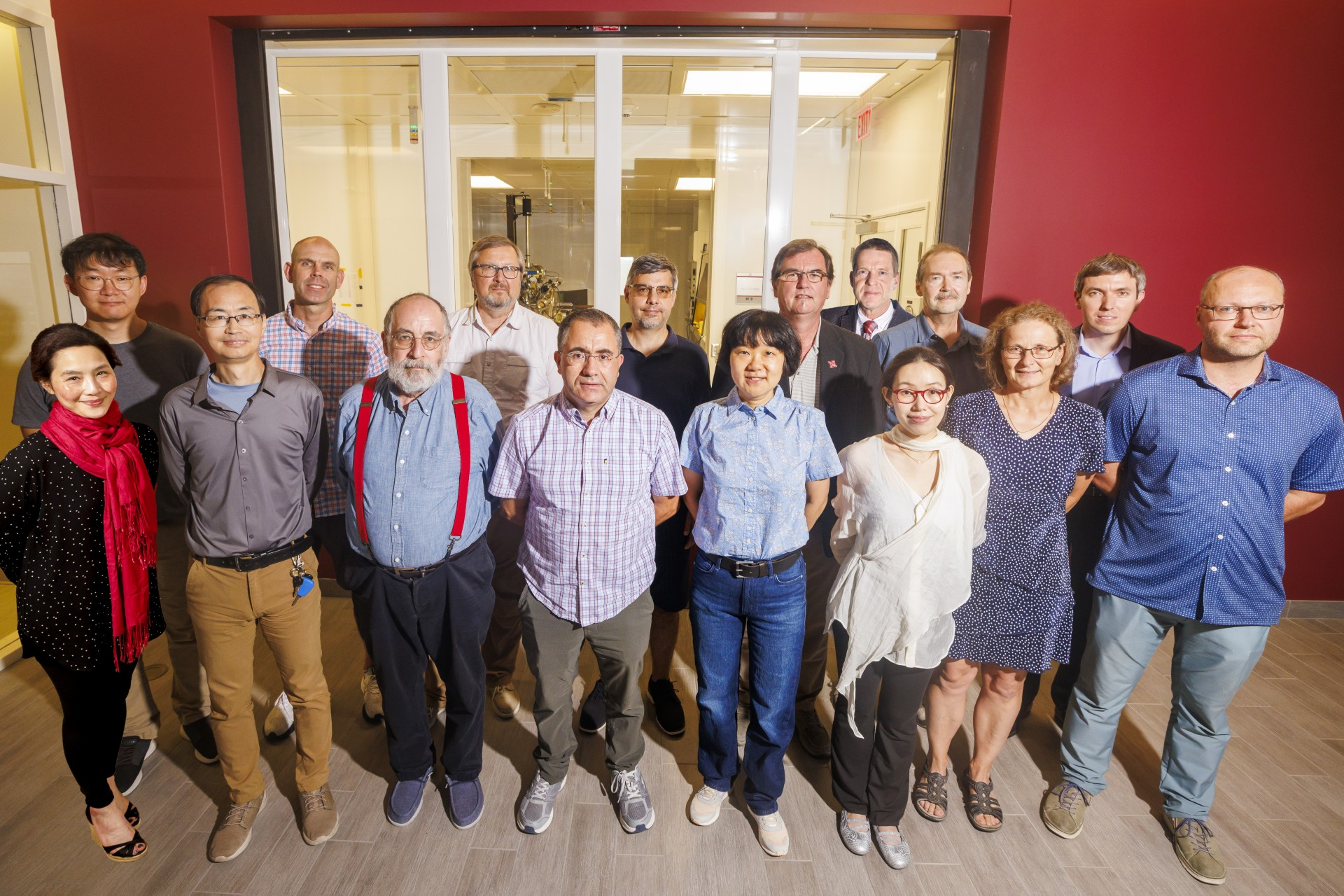 Dr. Christian Binek and members of Nebraska’s NSF-funded Atomically Engineered Materials Center are advancing research into faster, more energy-efficient technologies.
Strengthening American Competitiveness
Dr. Binek believes sustained federal investments in basic research are essential to America’s economic competitiveness and national security. Discoveries made in university laboratories can provide the foundation for technologies, products, and industries that do not yet exist.
“If you have better technology, you have better products, and you are more successful economically,” he said. “Only if we are economically successful can we have good lives and security.”
Earlier advances in quantum science helped enable semiconductors, lasers, and modern electronics. Research underway today could similarly lay the foundation for new computing, sensing, and communication technologies.
Curiosity as an Anchor
Dr. Binek encourages early-career scientists to remain curious, even as their responsibilities grow.
“Keep that fire alive as long as you can, because that’s where the magic comes from,” he said.
His career illustrates what’s possible when scientific curiosity is matched with sustained support. Federal funding has enabled Dr. Binek to develop ideas, build collaborative teams, and pursue discoveries that could help shape a more energy-efficient technological future.