
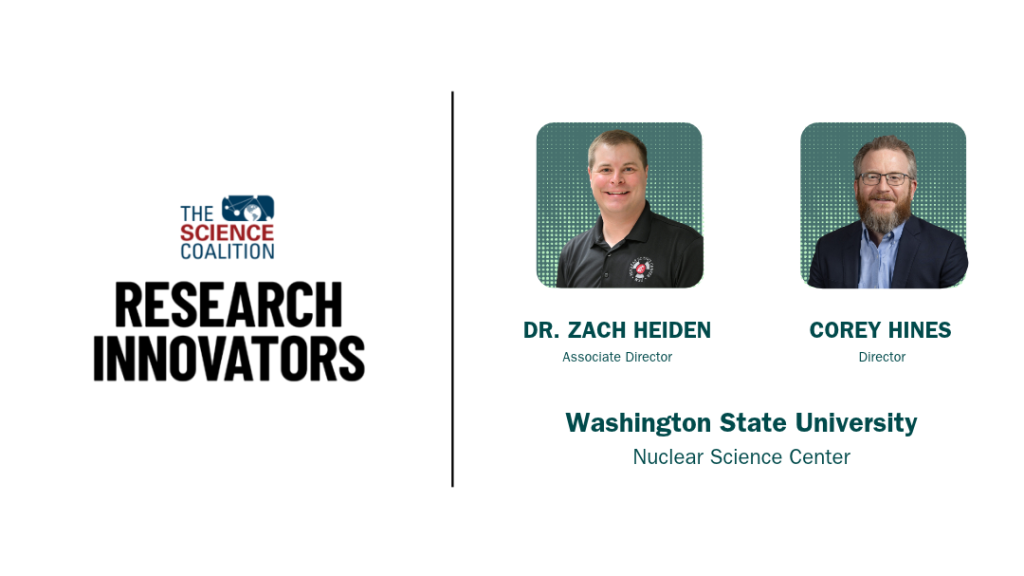
Dr. Zach Heiden and Corey Hines: Strengthening Nuclear Safety with Federal Investment
At Washington State University’s Nuclear Science Center, Dr. Zach Heiden and Corey Hines leverage federal funding to help prepare for potential radiological emergencies.
The center’s reactor, specialized equipment, and experienced personnel allow researchers to study radioactive materials, develop training resources, and pursue solutions for a range of safety and preparedness challenges. Federal support helps sustain this important work.
“The largest capability that we have at this center is the operation of the nuclear reactor,” Hines said. “That work receives federal funding for things like capability upgrades and reactor fuels.”
Their research projects include developing tools to decontaminate essential electronics, such as computers, phones, and data storage devices. In an emergency involving radioactive materials, the team’s decontamination solutions could make it possible to clean and return affected equipment to service quickly and safely.
For Heiden and Hines, federal investments help provide specialized facilities, equipment, and early-stage support to tackle novel nuclear safety and security problems.
Building Tools for Emergencies
The team’s decontamination research responds to a straightforward but consequential question: What happens when radioactive material impacts critical electronics?
Heiden and his colleagues test gels that are rolled and pressed directly onto contaminated electronics, covering the entire surface. After about five minutes, the gel is peeled off and discarded, taking the contamination with it.
From Ideas to Action
The work is still in development, but it shows why federal funding matters at the earliest stage. Emergency-response organizations won’t adopt a technology, and private investors won’t back it, until researchers show it works reliably, safely, and in real-world conditions. That testing takes years and carries no guaranteed commercial payoff, which is the gap federal research dollars fill.
Heiden emphasized the complementary roles of federal funding and private investments in advancing research.
“Private companies, they’re more focused on the applications,” Heiden said. “Federal funding can support the combination of basic and applied research — the in-between from the initial idea to the final product.”
This support allows researchers to test new approaches, collect technical evidence, and refine promising tools before they are ready for broader deployment. It also gives them room to pursue scientific questions that could shape future technologies.
Advice for Future Researchers
Both Heiden and Hines emphasized that scientific careers require adaptability, curiosity, and a willingness to keep learning. Heiden also encouraged students to seek practical opportunities alongside their coursework.
“Get hands-on experience with whatever you do,” he said. “A lot of people are hired because of their extracurriculars, not because they have a degree.”
He also stressed the value of building professional relationships early.
“Networking matters way more than you think when it comes to federal funding,” Heiden said. “You never know who’s going to review the proposals.”
Hines echoed the point, noting that informal conversations with colleagues about proposal ideas have often given him useful feedback. He recommended that early-career researchers avoid limiting themselves to a single discipline or assuming that learning ends with a degree.
“Don’t think that you’re done learning just after you defend your dissertation,” he said. “Because that’s kind of where it starts.”
Federal support for early stage research gives Heiden and Hines — and scientists at higher education institutions across the country — the capacity to prepare for threats before they become emergencies. At the Nuclear Science Center, sustained investment turns scientific questions into practical tools that can strengthen nuclear safety, protect critical infrastructure, and support national security.