

Dr. Timothy Glotch: Moon Rocks, Infrared Light, and the Return to the Lunar South Pole
As Professor and Chair of the Department of Geosciences at Stony Brook University, Dr. Timothy Glotch studies crusts of the Moon, Mars, and asteroids.
His basic scientific research, sustained over decades by federal investment, has helped build the knowledge needed to interpret planetary surfaces and samples that return from voyages into the final frontier. Dr. Glotch’s work has earned him a seat at one of the most important tables in American space science. In 2026, the National Aeronautics and Space Administration (NASA) named Dr. Glotch to a small team of experts shaping the Artemis mission’s research agenda, as our nation takes a new generation of astronauts to the lunar surface – and, for the first time, explores the Moon’s south pole.
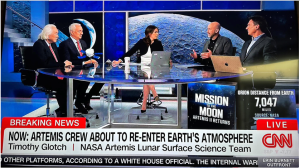 Dr. Tim Glotch (second from right) appeared on CNN’s Outfront with Erin Burnett to discuss the Artemis II mission in April, 2026.
A Telescope, and a Question That Stuck
Dr. Glotch traces his career to a specific object: The telescope his parents bought him when he was six or seven years old. A self-described "space geek" from the start, he spent childhood evenings watching the sky with his father.
At Colgate University, Dr. Glotch found an academic home for his interest in a place he didn’t expect. An undergraduate mentor pointed him toward astrogeophysics — a combination of physics, astronomy, and geology.
Reading Planets in Infrared
Today, Dr. Glotch leads the Vibrational Spectroscopy Laboratory at Stony Brook's Center for Planetary Exploration, where his group makes precise laboratory measurements of minerals, meteorites, and returned extraterrestrial samples.
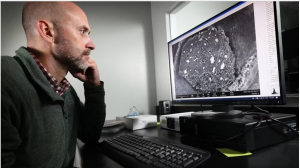 Dr. Tim Glotch uses a scanning electron microscope (SEM) to examine a grain of the near-Earth asteroid Ryugu returned by Japan’s Hayabusa2 spacecraft.
His group draws on instruments in space, including the Diviner Lunar Radiometer aboard NASA's Lunar Reconnaissance Orbiter, where Dr. Glotch has served as a Co-Investigator since 2009. Diviner data led him and his colleagues to one of the field's genuine surprises: Evidence of granite on the Moon. This type of rock typically requires plate tectonics or water-bearing magma to form, and the Moon has neither.
Dr. Glotch's lab is now examining these rare granitic fragments at micro- and nanoscale resolution to help determine their formation mechanism. He uses the same techniques to analyze samples of the near-Earth asteroid Bennu returned by NASA's OSIRIS-REx mission to understand the earliest geochemical processes that occurred in our Solar System.
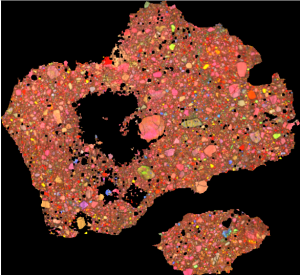 Composite false color infrared microscope image of a section of Apollo regolith breccia sample 14082,49. In this image, the different colors represent different mineral compositions. The small bluish-purple grains are granite. The image is about 1 cm across and the spatial resolution is 25 microns/pixel.
Built on Federal Investment
Nearly every element of Dr. Glotch’s work rests on sustained federal funding. NASA, the National Science Foundation (NSF), and the Department of Energy (DOE) support his laboratory's instrumentation, the analyses performed on irreplaceable samples, and the graduate students who carry the work forward. For example, Dr. Glotch received an NSF CAREER award to determine the fundamental infrared properties of minerals — foundational measurements that other researchers now rely on.
For more than a decade, he served as Principal Investigator of a node of NASA's Solar System Exploration Research Virtual Institute, coordinating scientists across more than a dozen institutions and running field campaigns that tested technologies for exploring the lunar surface and subsurface.
The most durable return on that investment may be the people. Dr. Glotch has advised 22 doctoral students. State funding typically covers a student's first year and federal grants sustain them through the remaining years of study.
"You cannot train a planetary scientist in a single funding cycle," Dr. Glotch says. "The instruments take years to build, the samples are irreplaceable, and the students need time to become independent researchers. Stable federal support is what makes all of it possible — and what keeps spacecraft that represent decades of taxpayer investment operating instead of going dark."
Advice for the Next Generation
Dr. Glotch recommends that people interested in space science should start with the fundamentals: Build a strong foundation in mathematics and physics, because quantitative thinking allows a researcher to move between disciplines.
His second piece of advice: Learn how funding works from the inside. As a postdoctoral researcher, he served on four or five proposal review panels a year and credits that experience with teaching him to write competitive proposals. He points early career scientists toward agency roles designed for exactly that purpose, and toward NASA's participating scientist programs, which add researchers to active missions and offer access to a well-credentialed professional network.
Where to Land, and What to Look For
For Artemis, Dr. Glotch helps determine which parts of the Moon offer the most scientific value and how to study permanently shadowed craters near the south pole. Some of those craters have not seen sunlight in billions of years and hold water ice, a scientific record of the inner solar system and a potential resource for a sustained human presence on the lunar surface.
Dr. Timothy Glotch's work shows how decades of federally funded basic research make ambitious national goals achievable.