Transportation Innovators: The Science Shaping U.S. Infrastructure
The roads we travel, the bridges we cross, and the materials that hold it all together are underpinned by strong federal investments in basic and advanced materials research conducted by colleges and universities across the country.
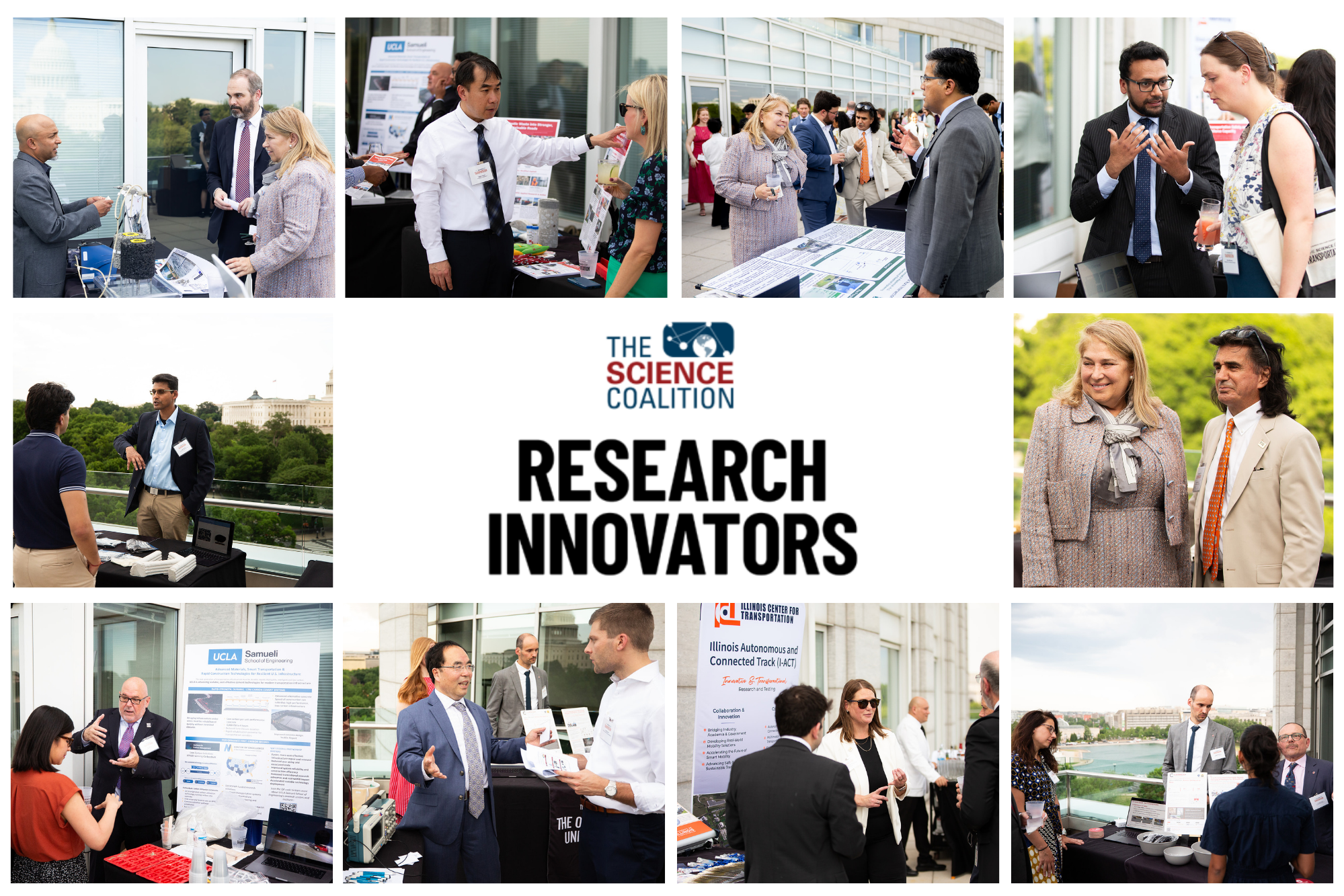
The Science Coalition (TSC) brought this idea to life at a recent event — “The Science of Transportation” — which convened more than 130 leaders from academia, industry, and government. Researchers from nine TSC member institutions participated in the official program and presented their cutting-edge transportation science projects.
For this month’s Research Innovators, we’re highlighting their work to advance the nation’s infrastructure ecosystem.
Florida International University
Researcher:
Atorod Azizinamini, Ph.D., P.E. — Professor, Department of Civil and Environmental Engineering
Dr. Atorod Azizinamini is a nationally recognized leader in infrastructure engineering. He serves as the Vasant Surti Professor of Civil Engineering and Director of both Infrastructure Research and Innovation, and the Accelerated Bridge Construction University Transportation Center at Florida International University. His research focuses on ultra-high-performance concrete (UHPC). Dr. Azizinamini’s FIU team recently developed a breakthrough spray-on UHPC system that can restore and strengthen structurally deficient bridges faster and more affordably than traditional methods.
Grounded in federally funded materials science and structural engineering research, this work advances scalable manufacturing techniques and deepens scientific understanding of UHPC's long-term behavior under real-world conditions. The implications extend across transportation, coastal, and defense infrastructure to directly advance national priorities in bridge preservation and infrastructure modernization.
Old Dominion University
Researchers:
Oleksandr Kravchenko, Ph.D. — Associate Professor, Mechanical & Aerospace Engineering
Tian-Bing Xu, Ph.D. — Professor, Mechanical & Aerospace Engineering
At Old Dominion University, Professors Oleksandr Kravchenko, Ph.D., and Tian-Bing Xu, Ph.D., are pushing the boundaries of what materials can do. Their research spans everything from spacecraft to clean energy and dynamic control, made possible by longstanding federal partnerships with NASA, the U.S. Air Force, the Department of War, and the Office of Naval Research.
Dr. Kravchenko works on lightweight composite materials like the high-performance plastics and carbon fiber structures increasingly used in aerospace and advanced engineering. He explores ways to improve the strength and durability of these materials. Dr. Kravchenko leads the Composites Modeling and Manufacturing Group at Old Dominion University where research focuses on the multi-scale nature of composites using computationally driven approach and artificial intelligence with experimental testing and material characterization.
Dr. Xu spent more than two decades developing smart materials and devices for NASA missions before joining ODU, and his current research endeavors take a similar shape, focusing on smart material systems for various sensing, actuations and dynamic controls to make the real world more visible and controllable. In addition, he also addresses the fundamental issues of smart material systems that can harvest usable electricity from mechanical energy sources that would otherwise go to waste. He finds ways to convert the power generated from vibrations, pressure, and the natural rise and fall of ocean waves into clean power that can be fed back into the grid or used to run sensors and devices in remote locations.
Together, these two researchers show how federal investments in basic materials science produce technologies that serve the nation — from lighter, stronger structures in space to new sources of clean energy here on Earth.
Pennsylvania State University
Researcher:
Vikash Gayah, Ph.D. — Director, Penn State Larson Transportation Institute
Dr. Vikash Gayah is a leading scholar in urban mobility, traffic operations, and transportation safety, and currently serves as Director of Penn State's Larson Transportation Institute. His research develops analytical models and empirical methods to understand and improve how traffic functions, with a particular focus on mixed traffic environments, including pedestrians and cyclists.
Dr. Gayah leads NSF-funded research that helps reduce traffic and improve surface transportation efficiency. His career is a testament to how sustained federal investments in fundamental transportation science generates tangible improvements to the nation's infrastructure.
The Ohio State University
Researchers:
Giorgio Rizzoni, Ph.D. — Professor, Department of Mechanical and Aerospace Engineering
Stephanie Stockar, Ph.D. — Associate Professor, Mechanical and Aerospace Engineering
Marcello Canova, Ph.D. — Professor, Mechanical and Aerospace Engineering
Responding to a national call to protect vulnerable road users, Professors Rizzoni and a team of students and researchers at The Ohio State University are developing cutting-edge sensing and AI-driven technologies that can identify, predict, and mitigate unsafe conditions at intersections in real time. This work has earned them one of only 15 spots in the first phase of the U.S. Department of Transportation's Intersection Safety Challenge.
With support from the National Science Foundation's (NSF) Dynamics, Control, and Systems Diagnostics Program and Graduate Research Fellowship Program, Professor Stockar's team is also advancing sophisticated mathematical models and control strategies that use connected and automated vehicles, and intelligent roadside infrastructure, to actively manage traffic flow in mixed-mobility environments, which can help reduce congestion and improve system reliability.
This work builds on a strong foundation of collaboration among Professors Canova, Rizzoni, Stockar, through the U.S. Department of Energy's ARPA-E NEXTCAR project, which explored how vehicle connectivity and varying levels of automation can improve fuel economy and energy efficiency. That research also helped advance broader understanding of connected and automated vehicle systems and their potential to improve transportation performance.
These efforts also drive critical workforce development by training the next generation of students at the intersection of control theory, data science, and transportation systems. Together, this portfolio of federally supported basic and applied research is generating practical tools for infrastructure planning, public safety, and national priorities in intelligent transportation.
University of Alaska Anchorage
Researcher:
Vinod Vasudevan, Ph.D., P.E. — Professor | Department of Civil Engineering
Alaska's vast rural landscape presents one of the most challenging frontiers in transportation data collection, where extreme weather and limited infrastructure make conventional traffic monitoring systems impractical. Backed by federal funding, Dr. Vinod Vasudevan aims to solve this problem.
At the University of Alaska Anchorage, Dr. Vasudevan developed and patented a self-powered smart lighting system that uses sensors to detect when a vehicle is approaching an intersection and automatically illuminates it on demand, warning drivers in advance and dramatically improving visibility in locations where permanent lighting would be too costly or impractical to maintain.
The system is specifically engineered to meet the cost, technical expertise, and workforce constraints of rural agencies, enabling them to collect reliable data that informs safety and transportation planning decisions. Funded by the Department of Transportation’s University Transportation Centers program, Dr. Vasudevan’s technology can scale well beyond Alaska, offering a replicable model for rural traffic monitoring nationwide and demonstrating exactly the kind of transformative impact yielded by federal investments in university research.
University of California Davis
Researcher:
Mohammad Ashiqur Rahman, Ph.D. — Postdoctoral Scholar, Civil and Environmental Engineering
Dr. Mohammad Ashiqur Rahman is a Postdoctoral Scholar in Civil and Environmental Engineering at the University of California, Davis, where he conducts research at the UC Pavement Research Center, one of the nation's centers for pavement science. His research, supported by federal and state agencies, focuses on the aging behavior of asphalt and the performance of pavement systems that incorporate high volumes of recycled materials. By developing the foundational scientific understanding of how recycled content mixes age and performance under real-world conditions, Dr. Rahman's work helps transportation agencies deploy more cost-effective construction practices without compromising safety or durability.
University of California Los Angeles
Researcher:
Eric Bescher, Ph.D. — Associate Adjunct Professor, Materials Science and Engineering
Dr. Eric Bescher studies how to build stronger, greener, and longer-lasting materials. His work focuses on next-generation concrete pavement, and his lab developed advanced cement formulations produced with a lower carbon footprint than conventional materials and are engineered to last up to 100 years, compared to the typical 20- to 30-year lifespan for standard road surfaces. Dr. Bescher’s innovations can result in fewer necessary repairs, lower maintenance costs, and less traffic congestion.
Dr. Bescher’s research focuses on advanced cement chemistry and next-generation infrastructure materials designed for rapid construction, extended service life, and transportation resilience. His work includes rapid-strength concrete technologies and durable pavement systems intended to improve mobility, enhance safety, reduce maintenance disruptions, and strengthen the long-term resilience of critical infrastructure.
Dr. Bescher's federally and industry-supported research is a compelling example of how investment in fundamental science pays dividends in infrastructure resilience.
University of Illinois
Researcher:
Ramez Hajj, Ph.D. — Assistant Professor of Civil and Environmental Engineering
Dr. Ramez Hajj is an Assistant Professor of Civil and Environmental Engineering at the University of Illinois Urbana-Champaign whose research spans the full spectrum of asphalt materials science, from investigating binder behavior at the molecular scale to solving network-level pavement infrastructure problems. Supported by the U.S. Department of Agriculture through the National Institute of Food and Agriculture, Dr. Hajj’s work is advancing bio-asphalt technologies that convert organic waste into sustainable pavement binders and fuels.
His lab is leveraging AI to modernize asphalt mixture and structural pavement design for next-generation heavy aircraft and freight, improve roadway safety, and inspect existing pavement infrastructure. His work also investigates the use of biochar-based fillers that reduce volatile compounds which improves worksite safety, demonstrating a holistic approach to pavement innovation.
University of Nebraska System
Researchers:
Nathan Huynh, Ph.D. — Chair of Engineering and Technology
Jamilla Teixeira, Ph.D. — Assistant Professor of Civil & Environmental Engineering
At the University of Nebraska–Lincoln, Dr. Nathan Huynh and Dr. Jamilla Teixeira are working to make America’s roads, bridges, and transportation infrastructure safer, more durable, and more sustainable.
Dr. Huynh serves as Director of the Nebraska Transportation Center (NTC), which conducts a broad portfolio of basic and applied research spanning traffic safety, traffic operations, logistics, advanced vehicle technologies, next-generation construction materials, and sustainable infrastructure solutions.
In support of the Federal Highway Administration’s (FHWA) Vision Zero initiative, Dr. Huynh and his colleagues at NTC conduct research aimed at eliminating traffic fatalities and serious injuries. NTC also contributes to the FHWA’s efforts to expand the use of ultra-high-performance concrete in bridge preservation by advancing research that translates foundational materials science into real-world infrastructure performance gains.
As part of NTC’s research portfolio, Dr. Teixeira’s lab is pioneering the use of recycled waste materials, including plastic bags, reclaimed asphalt pavement, and bio-oils derived from corn and soybeans, as sustainable materials for roadway construction. She also collaborates in studies on functionalizing "smart" pavement using thermochromic materials—coatings that respond to temperature changes—to reduce heat absorption in urban areas. Leveraging multiscale techniques, her lab advances pavement material testing and performance prediction to build more durable roads.
Together, NTC’s research and the work of faculty such as Drs. Huynh and Teixeira exemplify how sustained federal investment in university-based research produces breakthroughs that benefit national, state, and local roads and highway systems.
Washington State University
Researcher:
Ani Jayakaran, Ph.D. — Professor, Agriculture, Human, and Natural Resource Sciences
Dr. Ani Jayakaran is a Professor and Extension specialist at Washington State University whose work sits at the intersection of civil engineering, ecological engineering, and sustainable water resource management. Dr. Jayakaran focuses on developing and disseminating evidence-based strategies for Green Stormwater Infrastructure (GSI), systems that use natural processes to manage runoff, reduce flooding, and protect water quality.
His current research is creating the tools and technical guidance that planners and engineers need to optimize GSI placement in urban landscapes, including work on permeable pavements and their capacity to treat environmentally harmful tire wear particles. As a WSU Extension faculty member, Dr. Jayakaran translates federally supported basic research into accessible, applied guidance for transportation agencies, municipalities, and practitioners across the Pacific Northwest and beyond.
The Next Generation of America’s Roads, Bridges, and Transit
World-class U.S. infrastructure is made possible by university labs and researchers, like those highlighted here, backed by federal dollars. Sustained and robust federal funding for basic research at institutions helps power our economy, drive the efficient movement of people and goods, keep Americans safer, and build the nation’s transportation innovation leadership for years to come.