

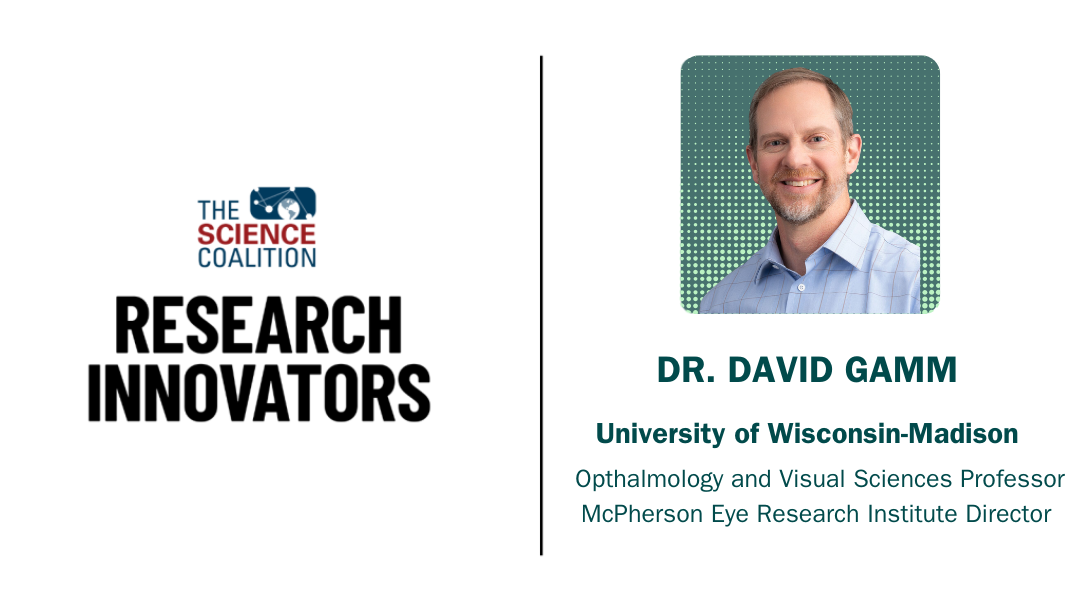
Dr. David Gamm: Engineering Vision from Stem Cells to Sight
As a physician-scientist at the University of Wisconsin–Madison’s Waisman Center and Director of the McPherson Eye Research Institute, Dr. David Gamm stands at the frontier of regenerative medicine. His lab has achieved what once seemed impossible: Growing functional human retinas in a dish. Years of persistence have turned that vision into reality, offering new hope for people affected by degenerative blindness and demonstrating the transformative power of sustained federal investment in basic research.
Where Curiosity Meets Care
Dr. Gamm’s path began with a fascination for how cells communicate. As an M.D./Ph.D. student at the University of Michigan – a prominent member of The Science Coalition – he explored how neurons signal one another, eventually discovering the chain reaction that begins the process of sight known as photoreduction in the retina. Ophthalmology offered him the perfect opportunity to understand disease in the lab and confront it in the clinic.
When choosing where to build his research career, Dr. Gamm was drawn to UW–Madison’s pioneering role as the birthplace of stem cell science. At the time, few in the field were studying the retina. Seizing the opportunity to chart new territory, he began developing ways to convert human embryonic and induced pluripotent stem (iPS) cells into retinal cells, a venture that would eventually revolutionize eye research.
Growing Human Retinas in the Lab
By the mid-to-late 2000s, Dr. Gamm and his collaborators succeeded in growing three-dimensional, light-sensitive retinas entirely in-vitro, a technology now patented and continually refined in his lab. These “mini-retinas” not only mimic authentic human tissue but can also model genetic diseases and test experimental interventions long before reaching patients.
His group’s progress helped inspire new ways of conducting in-vitro clinical trials, where potential gene and cell therapies can be screened in the lab before entering human studies. This approach dramatically accelerates discovery while reducing patient risk.
From Discovery to Therapy
Collaboration has always been central to Gamm’s success. Working across labs and sectors, his research helped launch Opsis Therapeutics, a Madison-based biotech company advancing stem-cell–derived treatments for retinal diseases. Supported by FujiFilm Cellular Dynamics, Opsis is currently conducting a clinical trial conducted by partner organizations in Boston, a direct outcome of public and private investment converging around the shared goal of restoring sight.
Many of these advances trace back to visionary federal programs such as the National Eye Institute’s Audacious Goals Initiative, which provided early funding to move retinal regeneration from concept to clinic. Ongoing support from the NIH, Department of Defense, and ARPA-H continue to propel Dr. Gamm’s work.
“The truth is, none of this happens without federal funding,” Dr. Gamm says. “It’s the backbone of basic science, the kind of work that takes years, even decades, to bear fruit. Our ability to model disease, test therapies, and eventually restore sight all stems from that foundation of sustained federal support. It’s investment with long-term returns for human health.”
Understanding How Retinas Are Built
Today, Dr. Gamm’s lab is delving deeper into developmental biology, decoding how human retinas form and identifying pitfalls in blinding disorders. Many of these conditions are rooted in single-gene mutations, but researchers still struggle to explain why those genetic changes lead to vision loss. By cultivating retinal tissue from patient-derived stem cells, his team can model these diseases in unparalleled detail, revealing fundamental mechanisms of degeneration and guiding targeted interventions.
Dr. David Gamm’s work demonstrates how federally funded basic scientific research can transform the future of medicine.